
An empty backpack tells you almost nothing about how it will feel on the walk from the station. Choosing a backpack for solo travel means testing the bag with the things you intend to carry, then checking it against the transport you have booked.
This is a selection guide, not a hands-on product ranking. Start with our solo female packing checklist, remove items that do not fit your trip, and use that actual load for every comparison. Buying the bag first can turn unused capacity into extra weight.
Decide whether your route needs a backpack
Picture the most awkward part of your journey. It may be steps outside a guesthouse, a station without convenient lift access, or a long airport walk. A backpack can help with steps while making long carries tiring. A suitcase reverses some of those trade-offs.
| Your likely journey | Backpack advantage | Rolling-case advantage |
|---|---|---|
| Frequent steps or uneven surfaces | No wheels to lift over each obstacle | Avoids a constant back load between obstacles |
| Long stretches on smooth floors | Hands remain free | Most weight stays on the floor |
| Small rooms and frequent unpacking | Compact if the design opens well | Easy access when laid open |
| Shoulder or back discomfort with a load | Requires a careful personal fit test | May reduce the need to carry the full load |
Neither choice guarantees comfort. If carrying a pack hurts during a short test, do not assume a more ambitious trip will fix the problem. Compare stops in our Italy destination directory, then look at the Italy-by-train itinerary, including the final walk to each hotel. If Venice is on your route, use the Venice city guide while planning a station-to-hotel journey that may involve bridges and steps.
Check the airline allowance before the capacity label
Liters describe interior volume, not whether an airline's gate agent will accept the bag. Check maximum external dimensions, weight, and whether your fare includes an overhead cabin bag or only an under-seat personal item. Repeat that check for every single airline in your itinerary:
- Ryanair: The free personal item allowance is 40 × 30 × 20 cm (must fit under the seat in front). A paid Priority ticket includes a second overhead cabin bag measuring up to 55 × 40 × 20 cm (maximum 10 kg).
- easyJet: The free small under-seat bag allowance is 45 × 36 × 20 cm. A booked Large cabin bag allows up to 56 × 45 × 25 cm (maximum 15 kg).
- U.S. Domestic Carriers (Delta, United, American): Standard overhead carry-on dimensions generally permit 22 × 14 × 9 inches (56 × 36 × 23 cm).
Measure the bag when fully loaded, including bulging front pockets, laptop sleeves, and protruding handles. A soft-sided travel bag can easily expand beyond its advertised depth when packed tight. Keep the booking's baggage allowance saved with your travel documents.
Also decide what you would remove if the main bag had to be gate-checked. Passport, backup cash, primary credit cards, prescription medication, and lithium battery power banks must remain in a compact personal crossbody bag that stays on your body. Check your carrier's current battery rules directly.
Test the harness with weight inside
Ask a shop to help adjust the pack or follow the manufacturer's fitting instructions. Torso fit matters more than whether the label calls the pack women's or unisex. Different bodies need different shapes and adjustment ranges.
Load the bag with your intended kit or equivalent test weight. Tighten the appropriate straps, walk around, and notice pressure points. Can you turn your head, reach the zips you need, and put the bag on without help? If the hip belt is part of the design, check how it sits and transfers the load for you.
Try sitting down, standing up, and passing through a doorway. Include the jacket you expect to wear. Leave enough time to compare more than one model rather than choosing the first one that feels acceptable for thirty seconds.
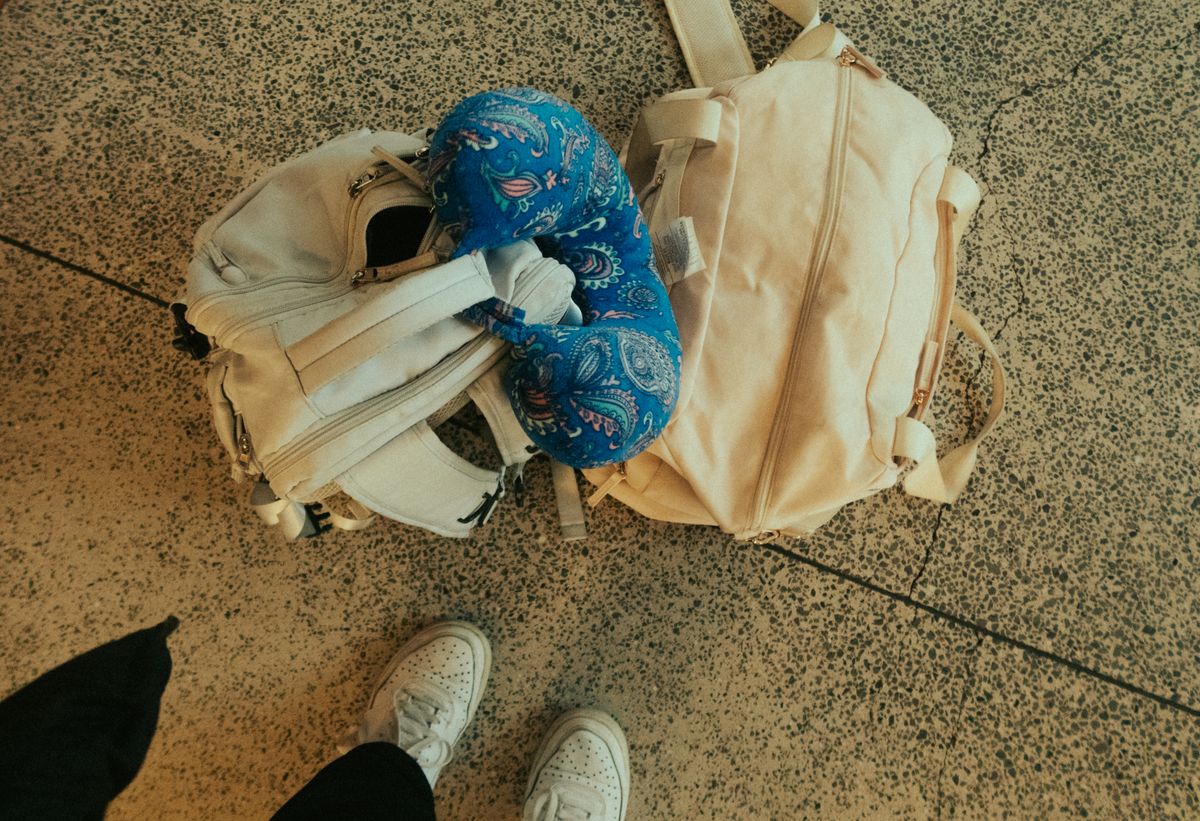
Illustrative stock photograph from Pexels, used under its license. The pictured bag is not a reviewed product.
Compare the opening and the small practical details
A front-opening main compartment lets you see more of the contents without pulling everything out. A top-opening bag may suit a different packing style. Put your own items into the candidate bag and see whether the layout works.
Check where a laptop sits, whether toiletries are accessible, and how the handles feel when lifting the bag. A stowable harness can help when straps might snag during storage. A water-bottle pocket is useful only if it holds your actual bottle securely.
For a concrete example, Osprey's Fairview 40 travel pack (MSRP ~€179.90 / $185–$200 USD) measures 55 × 35 × 23 cm and features an adjustable women's-specific harness, front-panel suitcase-style opening, lockable zipper sliders, and a stowable hip belt. While compliant with most U.S. and European legacy carriers, its 23 cm depth exceeds Ryanair's strict 20 cm depth allowance. If you pack it full, it will not slide into Ryanair's metal gate sizer box without forcing or incurring gate-check penalties. Test and measure the current version with your actual packed kit before departure.
Treat security features as small layers
A lockable zip can discourage casual access, but it does not make a bag theft-proof. Keep the bag under your control and keep essential items separate from luggage you may need to store out of reach.
Read our anti-theft gear article for related accessories, then verify any product specifications and testing claims that matter to your purchase. Avoid adding heavy security equipment simply because there is an attachment point for it.
In a crowded station, you should be able to close the main compartment and retrieve your ticket without displaying the contents. Practice that sequence before traveling. The safety handbook covers the wider arrival and transit plan.
Run one complete practice journey
Pack the bag fully, put on your travel shoes, and walk a realistic distance. Include stairs if your route contains them. Test whether you can lift the bag to the height required by your likely storage arrangements without straining.
Then remove everything you did not need to carry. If the load still feels wrong, compare a different pack or a rolling case. Our Europe rail guide helps you think through the actual transfers, and the first-trip guide covers preparation beyond luggage.
The best bag for this trip is the one that fits your body, contains a deliberate load, and works on your booked transport. Capacity and brand reputation come after those checks.